This article distills the training deck Layered Software Engineering Technology in the AI4SE Era: Effectiveness & Harmony, aimed at engineering managers, architects, and Champions who need to build organizational consensus on AI4SE methodology.
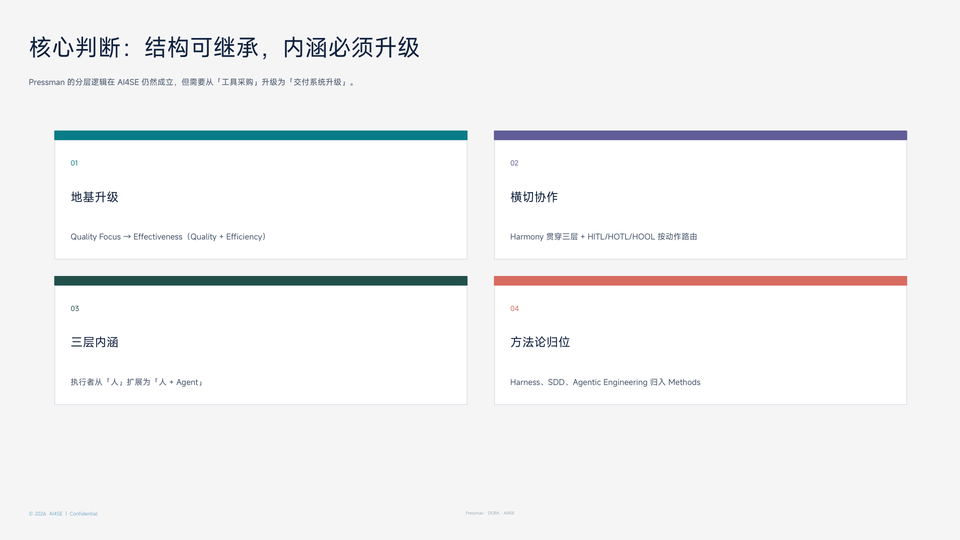
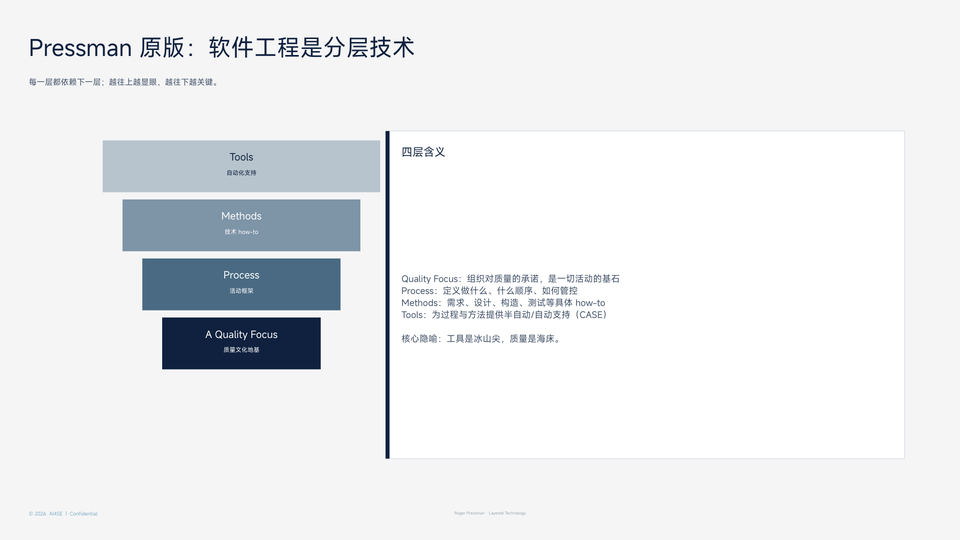
Roger Pressman, in Software Engineering: A Practitioner’s Approach, describes software engineering as four stacked layers of technology: Quality Focus → Process → Methods → Tools. This layered logic still holds in the AI4SE era — quality is still the foundation, process is still the glue, and tools still can’t fly solo — but three key evolutions are needed to support co-creative delivery by “human + Agent + Harness.”
A one-line definition:
AI4SE software engineering = governable co-creative delivery achieved on an Effectiveness foundation, with Harmony cross-cutting the human-machine division of labor, through upgraded Process / Methods / Tools.
Why Revisit Pressman
AI has changed interfaces, workflows, and how organizations collaborate, yet many teams still follow the path of “buy IDE plugins → expect ROI.” Pressman’s model is worth revisiting because it separates value trade-offs, process discipline, method systems, and tooling mechanisms into distinct layers — exactly the “engineering grammar” that organizations are most missing once AI amplifies output.
The Original Pressman Model
The classic model stacks bottom-up: the base layer is Quality Focus, followed by Process, Methods, and Tools. Each layer supports the one above it in a one-way dependency — without a quality culture, process becomes formalism; without process as glue, methods and tools each fight their own battles.
What Still Holds vs. What’s No Longer Enough
| Still holds | Why it matters more in the AI4SE era |
|---|---|
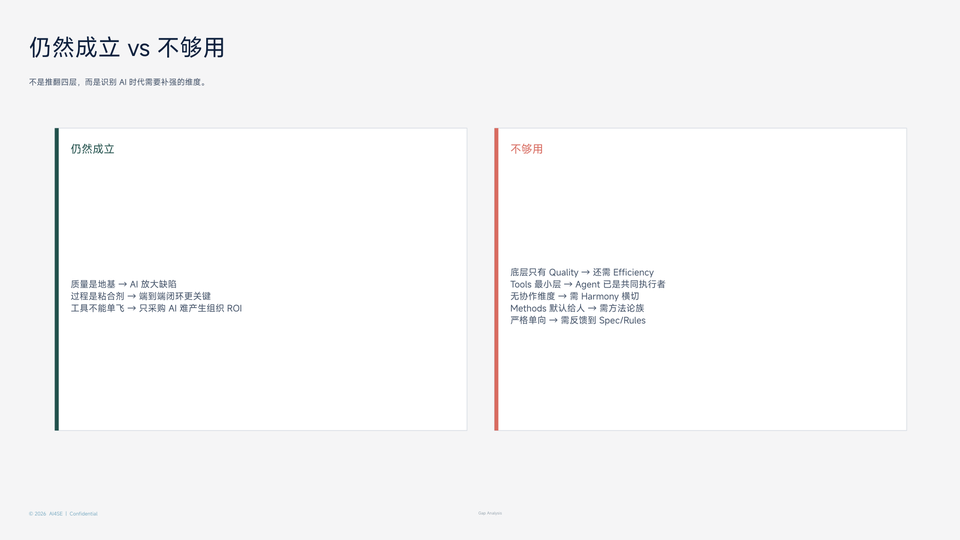
| Quality is the foundation | AI amplifies output — and defects along with it; without verification and review, rising change volume only creates more chaos |
| Process is the glue | End-to-end success depends on the closed loop of “spec → context → execute → verify → measure,” not IDE autocomplete |
| Tools can’t fly solo | Buying an AI IDE without changing process rarely produces organization-level ROI (DORA: AI is an amplifier) |
| No longer enough | AI4SE reality |
|---|---|
| The base layer contains only Quality | Teams face dual pressure to be both “fast” and “correct” |
| Tools drawn as the smallest layer | Agents have become co-executors, not a nice-to-have add-on |
| No collaboration dimension | It must be explicit who explores, who generates, who accepts, and who is accountable |
| Methods assumed to be for humans only | Must accommodate methodology families like Harness, SDD, and Agentic Engineering |
| Strictly one-way dependency | Metrics, incidents, and reviews should feed back into Spec, Rules, and Process |
The AI4SE Evolved Model
The three evolutions can be compressed into a single structural diagram:
[FOUNDATION] Effectiveness Focus = Quality + Efficiency
[CROSS-CUT] Harmony (Human <-> Agent) = roles, boundaries, handoffs, accountability, approval
[THREE LAYERS] Process -> Methods -> Tools (structure unchanged, meaning upgraded)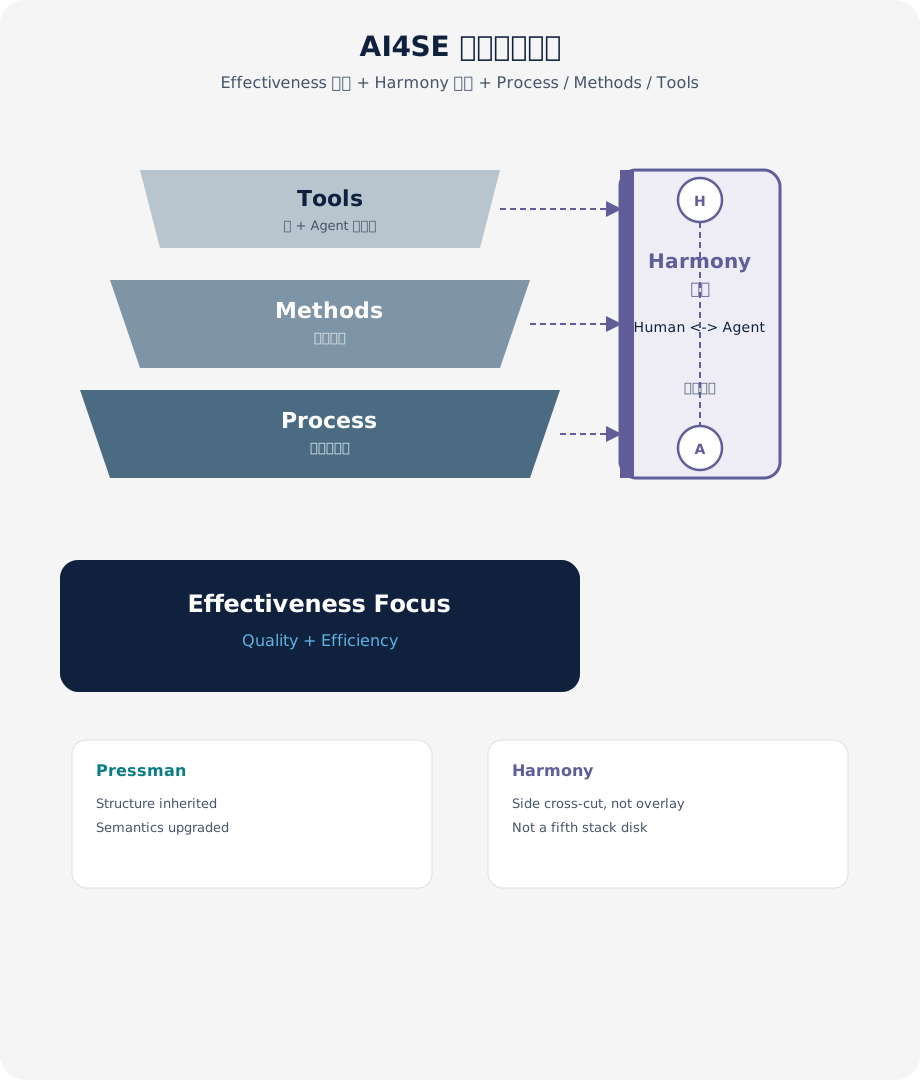
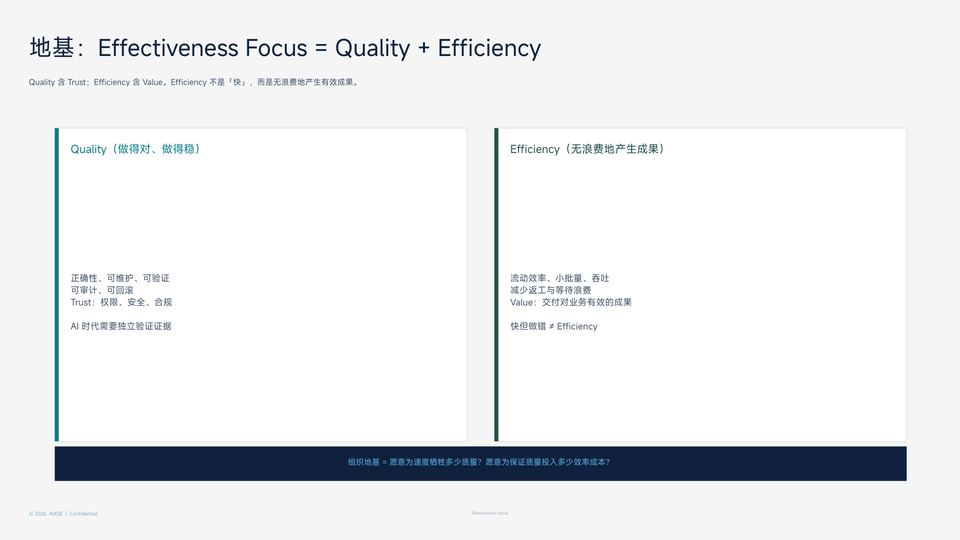
Effectiveness Focus: Quality + Efficiency
The foundation expands from a single Quality Focus into an Effectiveness Focus, made of two components:
| Component | Definition | Includes |
|---|---|---|
| Quality | Doing it right, doing it stably | Correctness, maintainability, verifiability, auditability, Trust (safety and security) |
| Efficiency | Producing outcomes without waste | Flow efficiency, small batches, throughput, Value (effective for the business) |
Worth repeating from the training deck:
- Efficiency is not “fast” — it’s producing effective outcomes without waste. Being fast but wrong is not Efficiency.
- Quality and Efficiency exist in tension; the foundation is a culture of value trade-offs — how much quality you’re willing to sacrifice for speed, and how much efficiency cost you’re willing to pay to guarantee quality.
Harmony: The Human-Machine Collaboration Contract
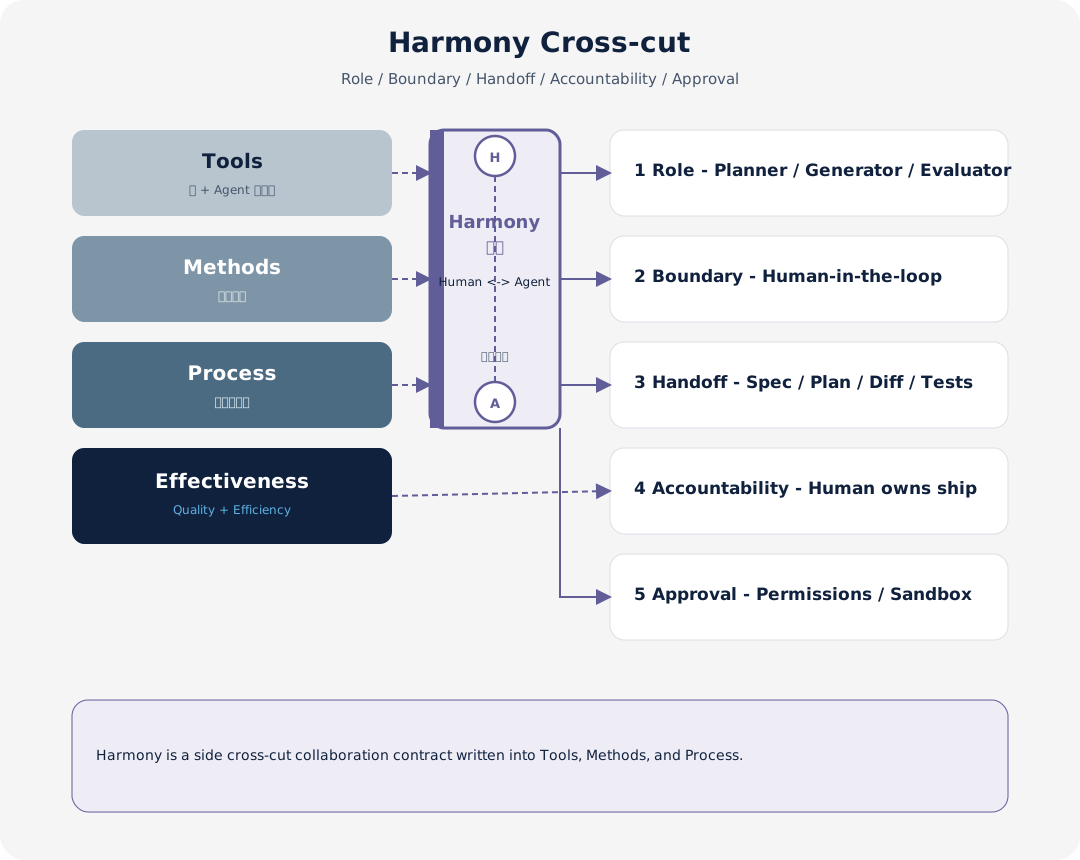
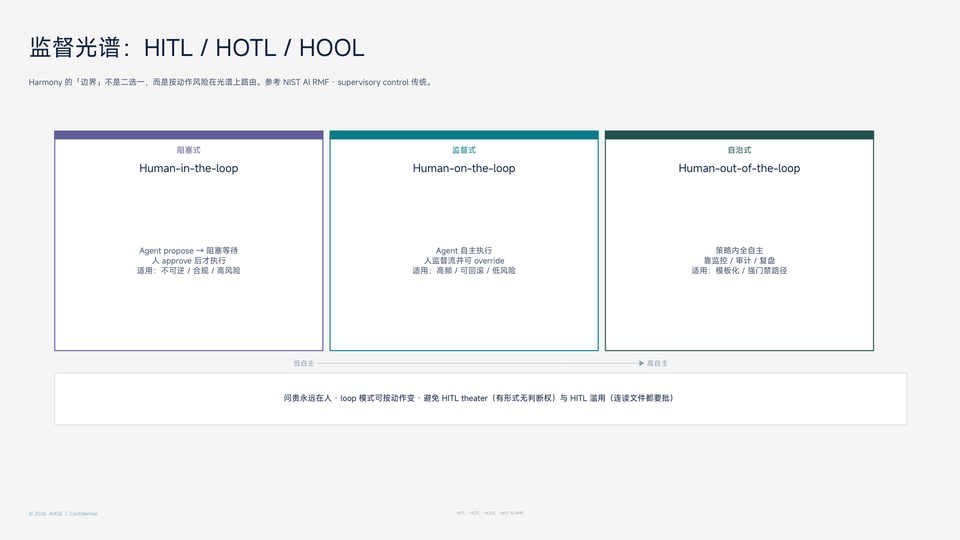
Harmony is not a fifth layer in the stack — it’s a cross-cutting collaboration contract that runs through Process / Methods / Tools. It doesn’t answer “can humans and AI get along,” but instead codifies roles, responsibilities, and handoffs into a system.
A Five-Dimension Collaboration Framework
| Dimension | Meaning |
|---|---|
| Roles | Planner / Generator / Evaluator — who plans, who generates, who independently accepts |
| Boundaries | Which actions the Agent may take autonomously, which require Human-in-the-loop |
| Handoffs | Spec, Plan, Diff, Test Log — the evidence exchanged between human and machine |
| Accountability | Merge, release, security — the human always bears responsibility |
| Approval | Permissions, sandboxes, hooks, audit logs |
The Supervision Spectrum: HITL / HOTL / HOOL
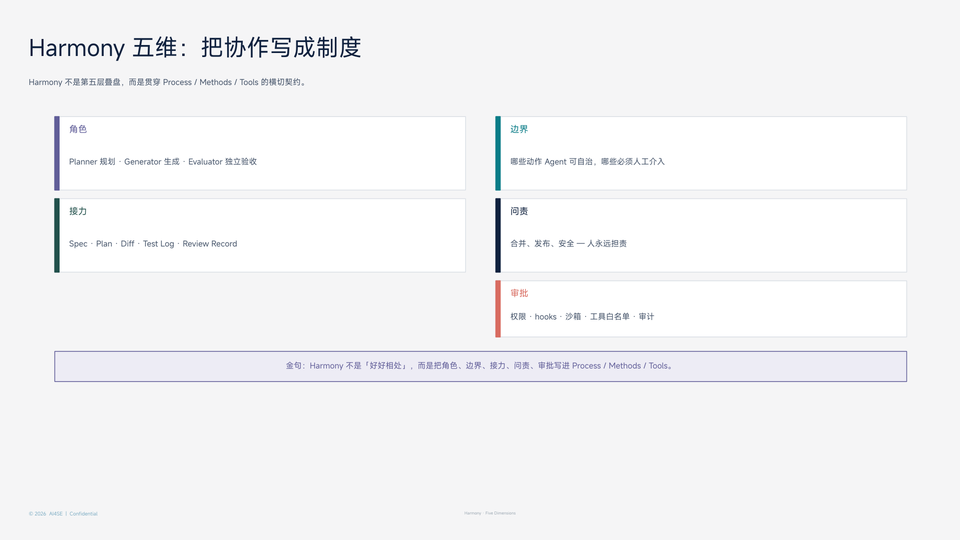
Harmony’s “boundaries” dimension shows up at runtime as a supervision spectrum — routed by the risk of the action, rather than applying a single mode everywhere:
| Mode | Meaning | When to use |
|---|---|---|
| Human-in-the-loop (HITL) | Agent proposes → blocks → human approves before execution | Irreversible, compliance-sensitive, high-risk actions (merges, releases, deleting data) |
| Human-on-the-loop (HOTL) | Agent executes autonomously; human supervises and can override | High-frequency, reversible actions (exploration, drafts, running tests) |
| Human-out-of-the-loop (HOOL) | Fully autonomous within policy + monitoring/audit | Templated, low-risk paths with strong gating |
Accountability always sits with the human; the Loop mode can vary by action.
Draws on Sheridan’s supervisory control theory, the human oversight requirements in the NIST AI RMF, and industry practice on layering HITL vs. HOTL.
Process × Loop Default Routing
Aligning Process steps with Loop modes is the key to moving Harmony from principle to daily practice:
| Step | Primary role | Loop | Key point |
|---|---|---|---|
| Research | Human + Agent | HOTL | Exploratory drafts, human supervises direction |
| Plan | Human-led | HITL | Spec / Plan sign-off |
| Execute | Agent | HOTL | Small sandboxed steps; escalate to HITL for high risk |
| Review | Independent Evaluator | HITL | Agent cannot self-evaluate |
| Ship | Human accountable | HITL | Merge / release |
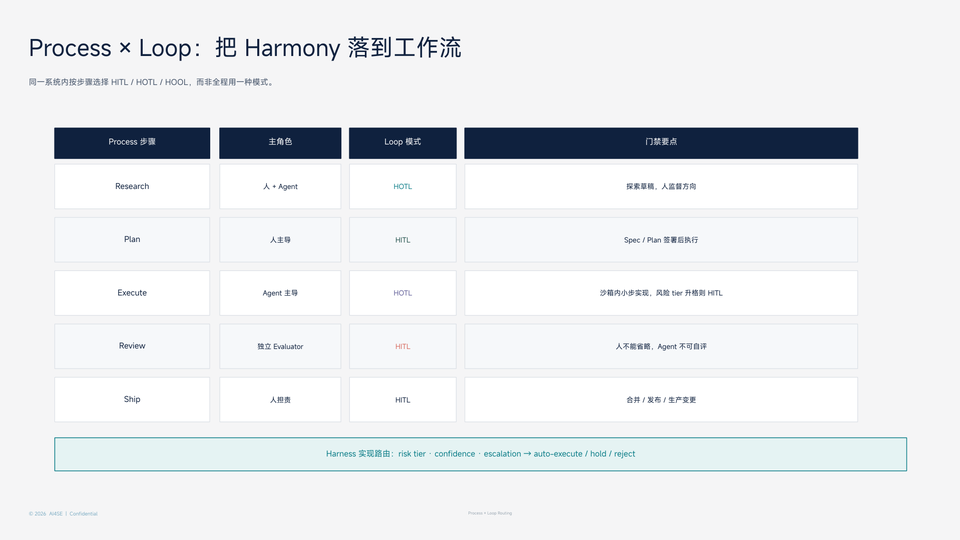
This is consistent with the closed-loop governance described in Inner / Middle / Outer Loop and Loop Engineering — the Loop mode is Harmony’s working vocabulary at runtime.
A Deep Dive Into the Three Layers
The structure is still Process → Methods → Tools, but the default executor shifts from “human + tools” to “human + Agent + Harness.”
The Process Layer: An Auditable Human-Machine Loop
It upgrades from a sequence of human activities into an auditable human-machine collaboration loop:
Research -> Plan -> Execute -> Review -> Ship
(Extensible: Policy & Routing -> Archive, Measure, Improve)
The core question: What must a human approve, and what can be handed to the Agent to run automatically?
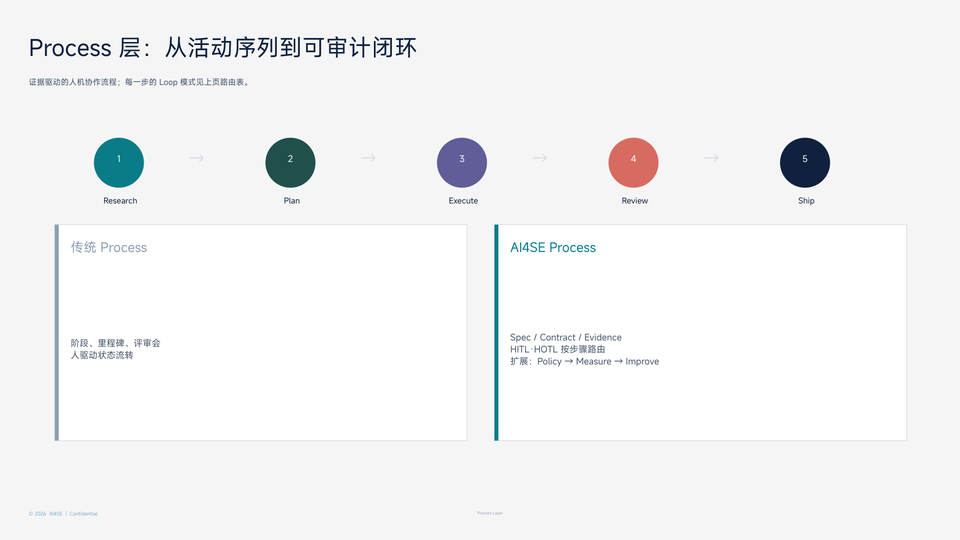
Harmony checklist for the Process layer: which step must a human approve? Which step can the Agent handle autonomously? Typical mechanisms include review gates, ship gates, and HITL/HOTL routing.
The Methods Layer: A Family Tree of Methodologies
The Methods layer is a container; Methodology is the individual school or system within it. The AI4SE era needs to accommodate new methodology families alongside traditional engineering discipline:
| Methodology | What it solves | Typical artifacts / practices |
|---|---|---|
| Agentic Engineering | How to make the Agent an engineering participant | Commands, Skills, Subagents, closed workflow loops |
| Harness Engineering | How to steer the model and constrain Agent behavior | AGENTS.md, Rules, Hooks, Permissions, Eval |
| SDD (Spec-Driven Development) | Where specs come from, how they change, how they’re accepted | OpenSpec, proposal/design/tasks, delta specs |
| Loop Engineering | How to turn Agent work into a governable closed loop | Inner / Middle / Outer Loop |
| Traditional methods | Human engineering discipline | TDD, refactoring, design patterns, code review |
The relationship: Methodology sets the discipline; Tools provide the mechanism. Avoid mechanically chaining OpenSpec, Superpowers, gstack, and similar tools without a clear division of labor — the Methods layer needs to make explicit who owns “spec / discipline / delivery.”
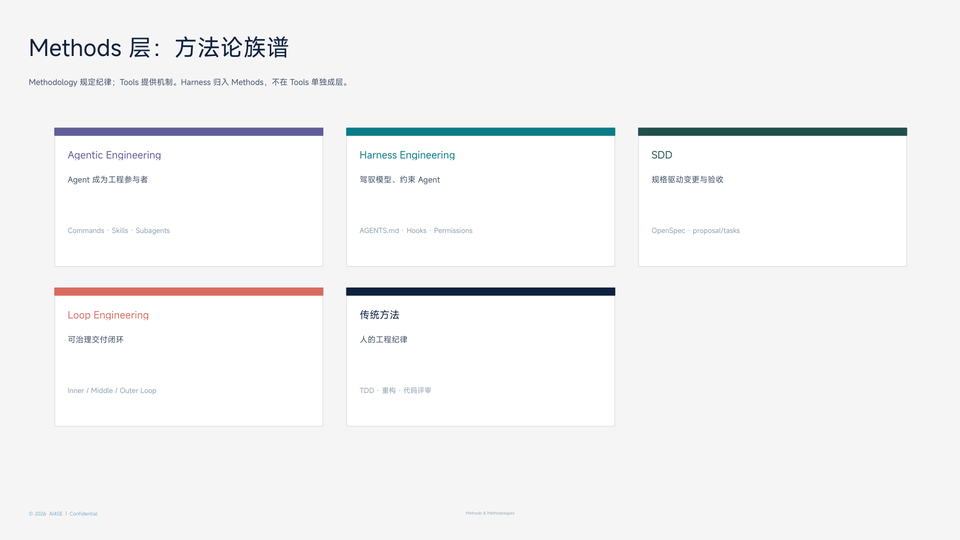
Harmony checklist for the Methods layer: which methodologies are human-led? Which can be encapsulated for the Agent? Typical mechanisms include independent review, spec sign-off, and separation of Planner/Generator/Evaluator roles.
The Tools Layer: Tools for Humans + a Runtime for Agents
The Tools layer expands from CASE-style assistance into tools for humans plus a runtime for Agents:
- IDE, CI/CD, Agent CLI, MCP, browser automation
- Permissions, context, state, evaluation (Eval)
- Humans configure the tools; Agents act within them
The core question: What can the Agent see, what can it change, and how does it stop when it fails?
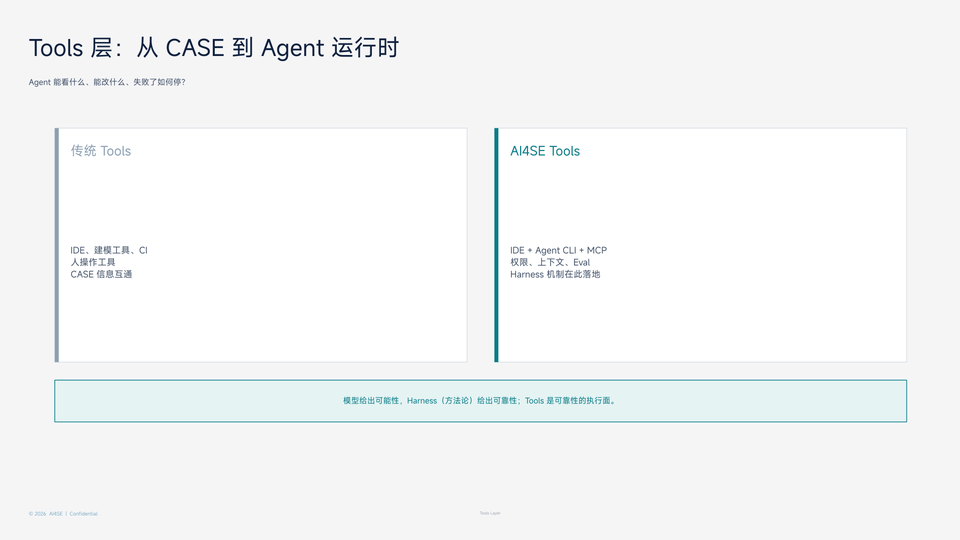
Harmony checklist for the Tools layer: how do you turn the division of labor into system behavior? Typical mechanisms include permissions, approvals, audit logs, sandboxes, and tool allowlists.
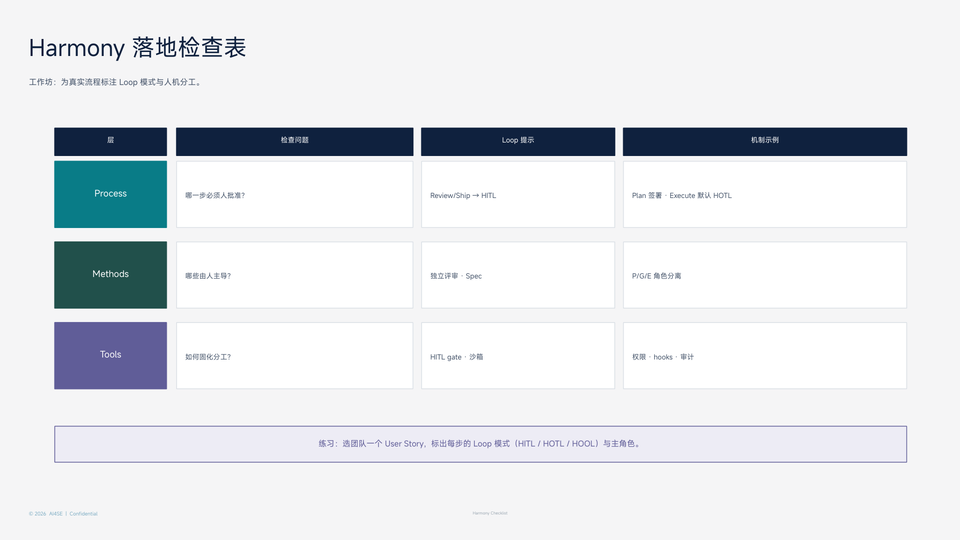
The Harmony Implementation Checklist
Aligning the Harmony five dimensions with the three-layer stack and Loop modes produces an actionable implementation checklist:
| Layer | Question Harmony answers | Loop mode | Typical mechanism |
|---|---|---|---|
| Process | Which step must a human approve? | HITL / HOTL routing | Review gates, ship gates |
| Methods | What’s human-led vs. encapsulated for the Agent? | Independent Evaluator | Spec sign-off, role separation |
| Tools | How is this codified into system behavior? | Approval + audit | Permissions, sandboxes, hooks |
Comparison With the Original Pressman Model
| Pressman original | AI4SE evolved version |
|---|---|
| A quality focus | Effectiveness Focus (Quality + Efficiency) |
| (none) | Harmony cross-cut (Human <-> Agent) |
| Process | Same name, upgraded to an auditable human-machine loop |
| Methods | Same name, extended with the AI4SE methodology family |
| Tools | Same name, includes the Agent runtime and Harness mechanisms |
Common Anti-Patterns
| Anti-pattern | Symptom | Response |
|---|---|---|
| Tools flying solo | Only buying Copilot/Cursor without changing review or testing | Realign value trade-offs from the Effectiveness foundation |
| Formalized process | Sprint/PR process exists, but no quality metrics | Quality includes Trust — requires verification evidence |
| Agent self-review as “done” | The same Agent that generated the work declares it complete | Harmony: an independent Evaluator |
| HITL theater | Every step is “approved,” but the human has no real judgment power | Real gates + action + reasoning |
| HITL overuse | Even reading a file requires human approval | Route by action to HOTL |
| Stacking methodologies | Mechanically chaining OpenSpec + Superpowers + gstack | Methods layer division: spec / discipline / delivery |
| Chasing local speed | Individuals get faster while system-wide MTTR worsens | Efficiency includes Value — look at end-to-end metrics |

Relationship to the Pilot Transformation Framework
This model provides the methodological foundation for organization-level AI4SE pilots. The Three Loops model (Inner / Harness / Outer Loop) in AI4SE Pilot Transformation for Mid-to-Large R&D Organizations echoes this article’s Process × Loop routing: when designing a pilot, use Effectiveness to align value trade-offs, use Harmony to define the human-machine division of labor, and then select and implement across the Process / Methods / Tools layers.
References
- Roger Pressman, Software Engineering: A Practitioner’s Approach — Layered Technology
- Google DORA 2025 — AI as amplifier
- NIST AI Risk Management Framework — human oversight
- Sheridan, Telerobotics, Automation, and Human Supervisory Control (1992)
- neurals: Human-in-the-loop vs on-the-loop
- Elementum: HITL for agentic AI