This article distills the full proposal AI4SE Pilot Transformation for Mid-to-Large R&D Organizations, aimed at technical leaders and architects designing an AI4SE pilot inside a large organization.
Software engineering is entering a new wave of technological disruption: AI is changing interfaces, workflows, and how organizations collaborate. But the biggest reality right now is that no one holds the single correct answer. Tools, models, processes, and organizational patterns are all still evolving rapidly; large organizations also can’t simply copy how individual developers or startup teams use these tools.
What this article offers isn’t a universal template, but a consulting-style pilot framework for finding as much certainty as possible amid uncertainty: identify assumptions → design an adapted path → run a real pilot alongside the team → distill your own method.
Background: Why a Consulting-Style Pilot
| Stage | Action | Output |
|---|---|---|
| Identify uncertainty | Trends, tools, processes, and organizational constraints together form the pilot’s assumptions | A risk list, boundary conditions |
| Design an adapted path | Choose scenarios, teams, metrics, and governance boundaries based on the current state | A pilot plan |
| Run a real pilot alongside the team | Validate the workflow on real codebases and real delivery tasks | Measurable evidence |
| Distill your own method | Form reusable assets, dashboards, and a rollout roadmap | An organization-specific AI4SE path |
Goal: reduce the trial-and-error cost of blind procurement and unstructured experimentation, and turn individual experience into a reproducible playbook, templates, skills, and a continuous improvement mechanism.
The Three Loops Model: Engineering Certainty for AI4SE
The proposal uses The Three Loops model to describe how AI work gets engineered into something stable — consistent with Inner / Middle / Outer Loop, but placing more emphasis on Harness as the governance function of the middle loop.
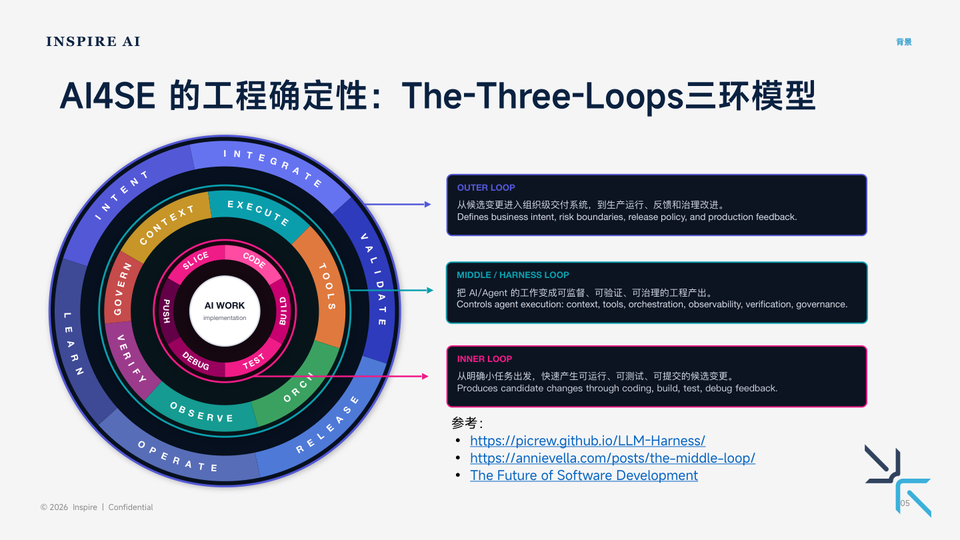
Inner Loop — The Implementation Ring
Starting from a clearly scoped small task, quickly produces a runnable, testable, committable candidate change.
| Step | Meaning |
|---|---|
| SLICE | Break down into a small task |
| CODE | Implement |
| BUILD / TEST / DEBUG | Build, verify, fix |
| PUSH | Submit the candidate change |
Maps to the day-to-day pair coding and agent collaboration at L2-L3 in the Agentic Engineering Capability Spectrum.
Middle / Harness Loop — The Governance Ring
Turns AI/agent work into an engineering output that is supervisable, verifiable, and governable.
| Step | Meaning |
|---|---|
| CONTEXT | Context engineering |
| EXECUTE / TOOLS / ORCH | Execution, tools, orchestration |
| OBSERVE / VERIFY | Observability, verification |
| GOVERN | Permissions, audit, gates |
See Harness Engineering and Loop Engineering for more.
Outer Loop — The Delivery Ring
From candidate change into the organization’s delivery system, through production operation, feedback, and governance improvement.
| Step | Meaning |
|---|---|
| INTENT | Business intent and risk boundaries |
| INTEGRATE / VALIDATE | Integration and acceptance |
| RELEASE / OPERATE | Release and operation |
| LEARN | Metric feedback, improving Rules/Process |
Maps to the Outer Loop and the DORA amplifier perspective in AI4SE End-to-End Best Practices.
Target State: From Individual Tools to an Organizational Engineering System
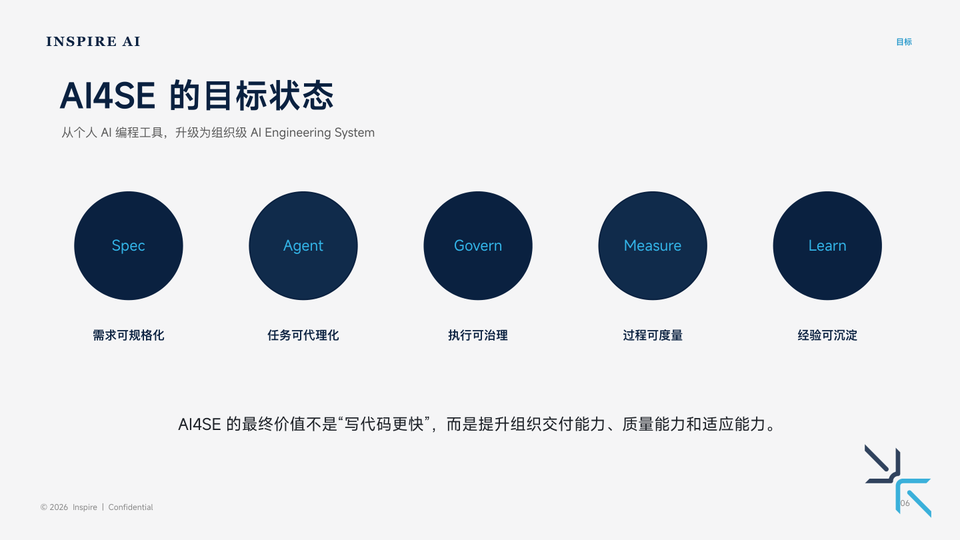
AI4SE’s goal isn’t “everyone knows how to use Copilot” — it’s upgrading individual AI coding tools into an organization-level AI engineering system:
| Dimension | Goal |
|---|---|
| Spec | Requirements can be turned into specs |
| Agent | Tasks can be delegated to agents |
| Measure | Process can be measured |
| Learn | Experience can be captured |
Four Core Directions: One Capability Chain
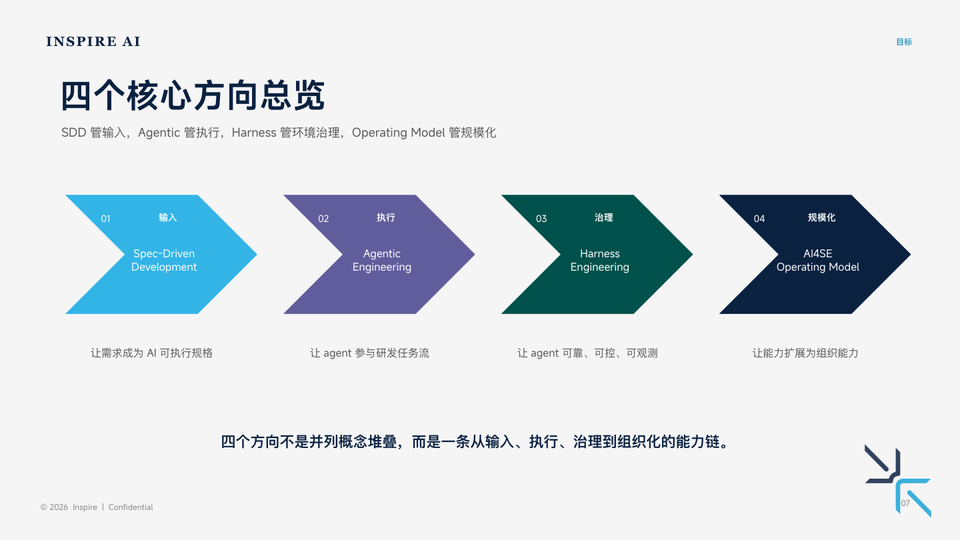
The four directions aren’t a parallel pile of concepts — they form a single capability chain running from input → execution → governance → organization-wide scale:
| # | Direction | What it governs | In one line |
|---|---|---|---|
| 01 | Spec-Driven Development | Input | Turns requirements into AI-executable specs |
| 02 | Agentic Engineering | Execution | Brings agents into the R&D task flow |
| 03 | Harness Engineering | Governance | Makes agents reliable, controllable, observable |
| 04 | AI4SE Operating Model | Scale | Extends capability into organizational capability |
Direction One: SDD — Input Quality
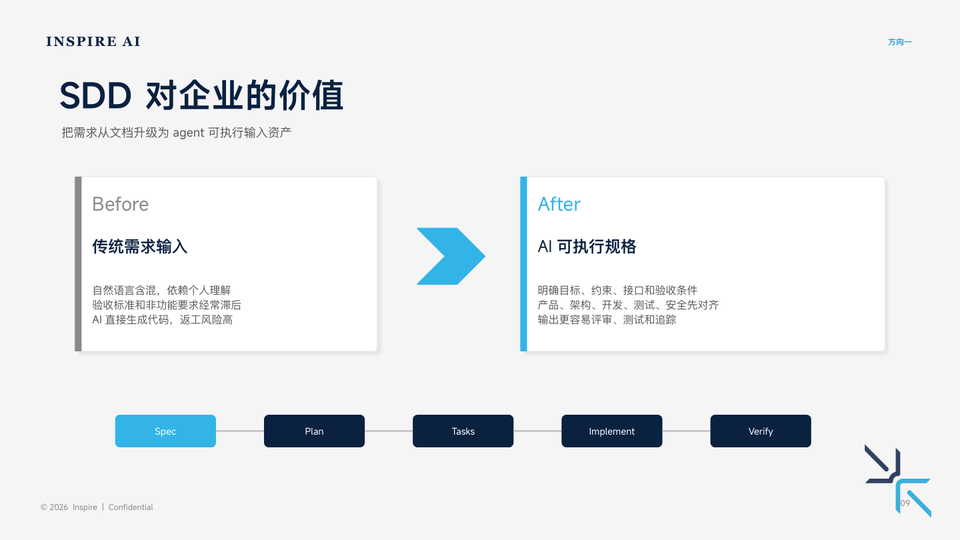
Upgrades requirements from a document into an asset that agents can execute against.
| Traditional requirement input | AI-executable spec |
|---|---|
| Natural language is ambiguous, depends on individual interpretation | Explicit goals, constraints, interfaces, and acceptance criteria |
| Acceptance criteria and non-functional requirements often lag behind | Product, architecture, dev, QA, and security align up front |
| AI generates code directly, high rework risk | Output is easier to review, test, and trace |
Main path: business requirement → Spec → Plan. Further reading: SDD: The Single Source of Truth, SDD Tools Compared.
Direction Two: Agentic Engineering — Execution Efficiency
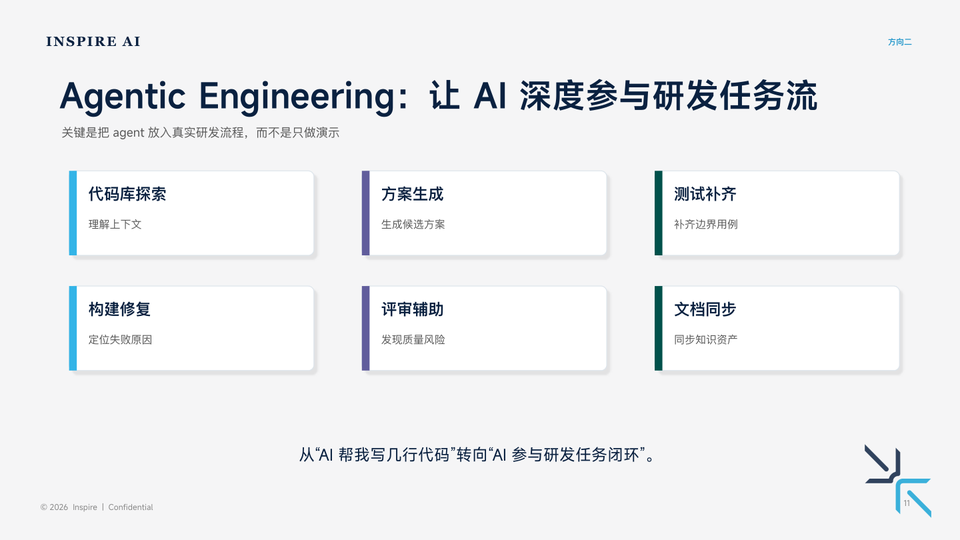
Upgrades AI from an autocomplete tool into an engineering collaborator that can participate in real R&D tasks.
Typical task flow: codebase exploration → solution generation → test coverage → build fixes → review assistance → documentation sync.
Human-machine division of labor:
| Human engineer | AI Agent |
|---|---|
| Defines goals and business boundaries | Retrieves code and documentation context |
| Judges context and architectural trade-offs | Generates candidate solutions and initial implementations |
| Reviews the result and owns quality accountability | Assists with testing, fixes, and organizing knowledge |
See The Agentic Capability Spectrum and Core Concepts of Agents for more.
Direction Three: Harness Engineering — Environment Governance
Model capability is just the base layer — the Harness determines enterprise usability:
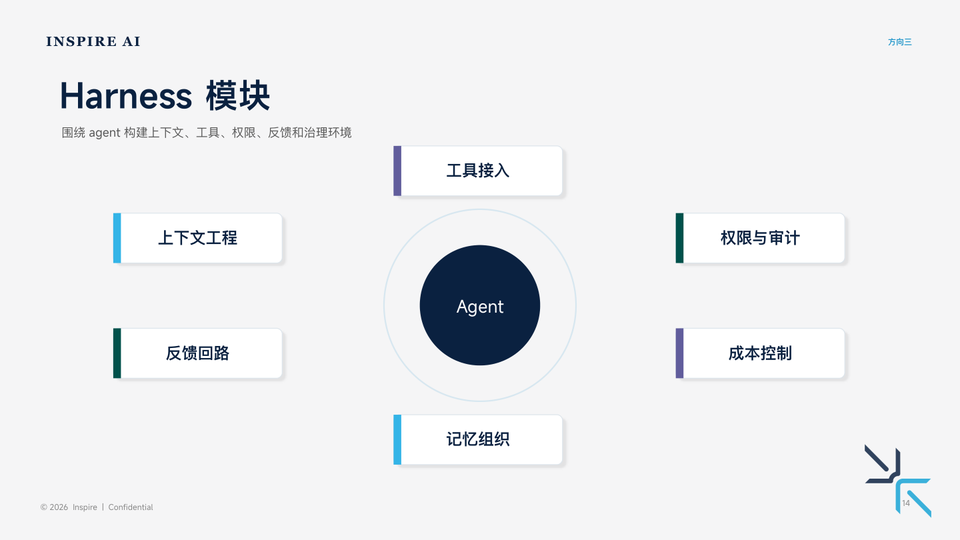
Agent = Model + Harness
Harness modules: context engineering, tool integration, permissions and audit, feedback loops, memory organization, cost control.
Quality gates and knowledge capture fold into the Harness: Test → Review → Security → PR Gate; Rules, Skills, Templates, and Runbooks are captured as assets the agent can read. A reference example: ECC organizes Agents, Skills, Rules, Hooks, and MCP into a cross-tool R&D operating system.
Direction Four: AI4SE Operating Model — Organizational Scale
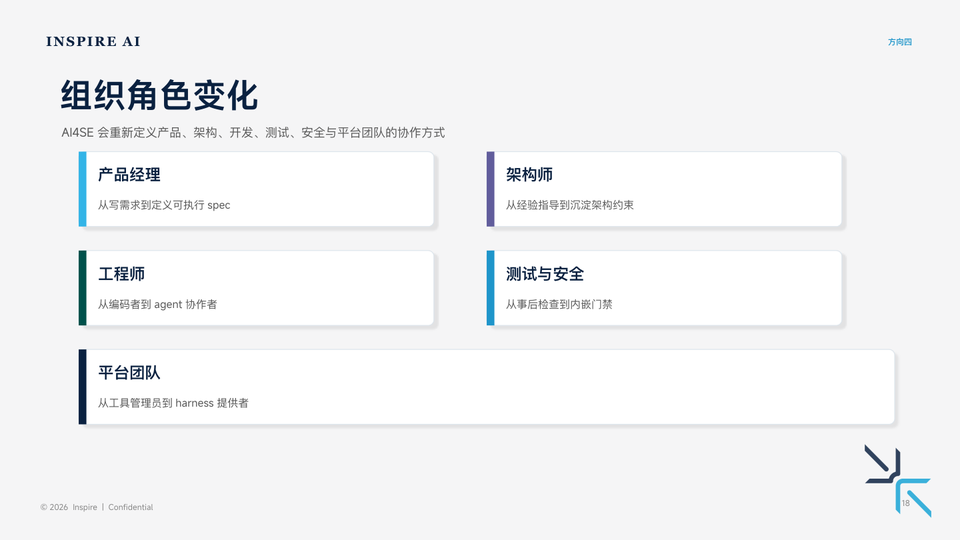
Extends AI capability from individual productivity into governable, replicable organizational capability.
| Role | Shift |
|---|---|
| Product manager | From writing requirements → defining executable specs |
| Architect | From experience-based guidance → codifying architectural constraints |
| Engineer | From coder → agent collaborator |
| QA and security | From after-the-fact checks → embedded gates |
| Platform team | From tool administrator → Harness provider |
 This echoes the Effectiveness foundation and Harmony cross-cutting layer in the AI4SE Layered Technology Model.
Maturity Diagnosis: Eight Domains, Not Eight Slogans
The proposal assesses current state across eight diagnostic domains (customizable per organization), used as an assessment framework, not a checklist of goals:
| Domain | Focus |
|---|---|
| Spec-driven | How structured requirements are |
| Agent workflow | Maturity of agent participation in the task flow |
| Context engineering | Context packs, rules, retrieval |
| Quality gates | Testing, review, security embedded |
| Security governance | Data boundaries, tool tiers |
| Cost efficiency | Token/task, routing strategy |
| Platform integration | CI/CD, MCP, IDP |
| Knowledge capture | Skills, templates, runbooks |
Diagnostic output: maturity scores, a risk list, pilot priorities, a rollout roadmap.
Four principles for choosing pilot scenarios: high value, measurable, controllable risk, and a signal visible within 4-8 weeks. Recommended combinations covering high-frequency activities: requirements-to-technical-design, legacy code comprehension, test coverage, code review, build fixes, security checks, documentation sync, PR summaries, and similar.
The Pilot Golden Path
Strings the four directions into a single executable, governable, measurable R&D main flow:
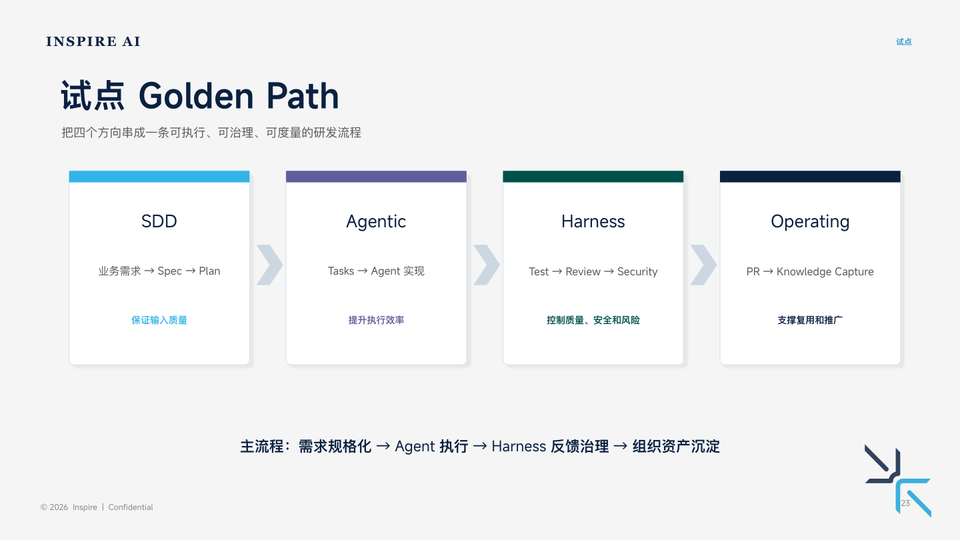
Main flow: requirement specification -> agent execution -> Harness feedback governance -> organizational asset capture| Stage | Path | Goal |
|---|---|---|
| SDD | Business requirement → Spec → Plan | Guarantee input quality |
| Agentic | Tasks → agent implementation | Improve execution efficiency |
| Harness | Test → Review → Security | Control quality, security, and risk |
| Operating | PR → Knowledge Capture | Support reuse and rollout |
For toolchain implementation, see the OpenSpec + Superpowers + gstack Integration Stack.
An 8-Week Consulting Pilot Plan
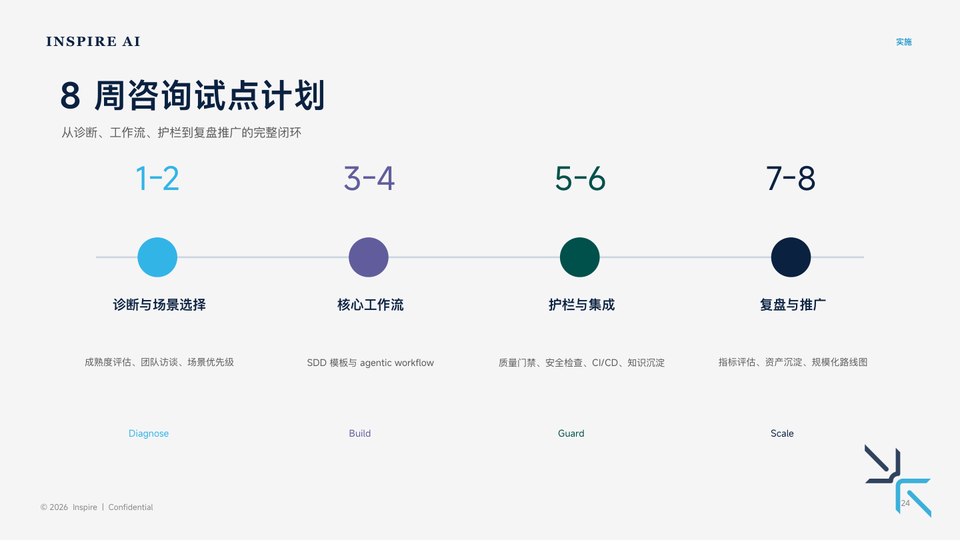
| Phase | Duration | Focus |
|---|---|---|
| Diagnosis and scenario selection | Weeks 1-2 | Maturity assessment, team interviews, scenario prioritization |
| Core workflow | Weeks 3-4 | SDD templates and agentic workflows |
| Guardrails and integration | Weeks 5-6 | Quality gates, security checks, CI/CD, knowledge capture |
| Retrospective and rollout | Weeks 7-8 | Metrics review, asset capture, scale-out roadmap |
Pilot deliverables: maturity diagnostic report, pilot scenario list, SDD templates, an agentic workflow playbook, Harness configuration recommendations, a team Rules/Skills asset package, a metrics dashboard, and a rollout roadmap.
Metrics and Risk
Avoid vanity metrics like lines of code, number of calls, or PR count alone:
| Dimension | Example metrics |
|---|---|
| Efficiency | PR turnaround, build-fix time, requirement-to-launch cycle |
| Quality | Rework rate, defect rate, test coverage, review-issue density |
| Organizational | Adoption rate, asset reuse count, developer experience |
| Governance | Security interceptions, cost visibility, compliance incidents |
Risk-control principle: validate first (small-scale real pilot) → govern next (quality gates and human accountability) → scale last (replicate and roll out based on metrics).
Key Decisions for Leadership
Before launching a pilot, it’s worth clarifying five things:
- Pilot team — who’s participating, who’s the Champion
- Tool scope — Tier 1 / Tier 2 tool policy
- Data permissions — which code/data can enter the agent
- Success metrics — efficiency, quality, organizational, and governance dimensions
- Governance boundaries and rollout conditions — when to scale up, when to pause
One-Page Summary
| Current judgment | The industry still has no single best practice; blindly copying others isn’t wise, but neither is waiting indefinitely |
| Recommended action | Run an 8-week consulting-style pilot to validate scenarios, process, metrics, and governance boundaries with a real team |
| Expected outcome | A reproducible AI4SE workflow, asset package, maturity diagnosis, and scale-out roadmap |
| Decision recommendation | Start with a small real pilot, then decide whether to scale based on the metrics |
AI4SE is a transformation of how R&D works, not a tool purchase. The Three Loops model provides engineering certainty, the four directions provide the capability chain, and the Golden Path provides an executable main flow — ultimately forming an AI4SE path that fits your own organization through real engineering practice.